A2A Training Center - VR Simulator for Medium-Voltage Substation Operations

— A2A (Unareti)

A2A Training Center - VR Simulator for Medium-Voltage Substation Operations
How do you train electrical grid operators when the grid can't be shut down?

Technical training quality doesn’t depend on theory. It depends on repetition. How many times an operator has performed the procedure before facing the real case. But on medium-voltage substations, repetition is a luxury: few senior tutors available, live substations that must stay in service, new hires waiting their turn to practice. With A2A we tackled this bottleneck by building a virtual training center where repetition stops being a constraint and becomes a choice.

Technology
VR Experience
Case study
Procedural Training
Industry
Energy
The challenge

Switching operations on secondary medium-voltage substations require deep procedural knowledge, manual coordination, and the ability to recognize the correct state of each switchgear panel before every action. An error can cause service outages, damage the equipment, or put operator safety at risk.

The traditional training method relies on on-field mentoring on real substations, with long timelines and the need to schedule interventions in ways that are compatible with the grid’s operations. The result is a funnel: few senior operators available to act as tutors, live substations that can’t be interrupted, and new hires waiting their turn to practice.

A2A, through its distribution company Unareti, wanted to tackle this problem with a different approach: building a virtual training center where operators could practice real procedures, without logistical constraints and without ever putting anything or anyone at risk.

The solution

We designed and developed the A2A Training Center, a custom VR application on Meta Quest 3 dedicated to operational training on medium-voltage substations.

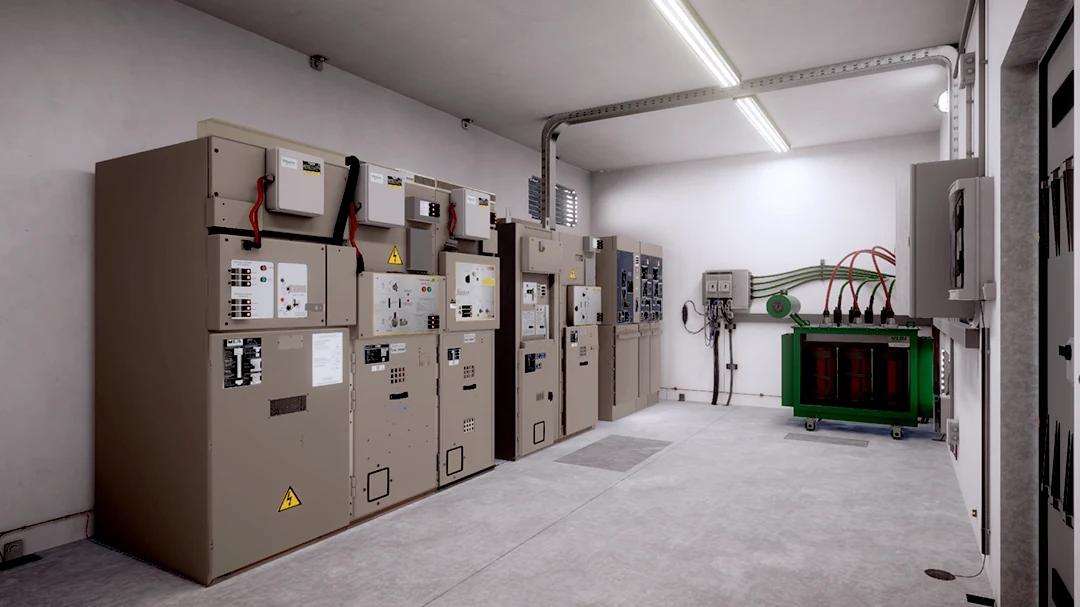
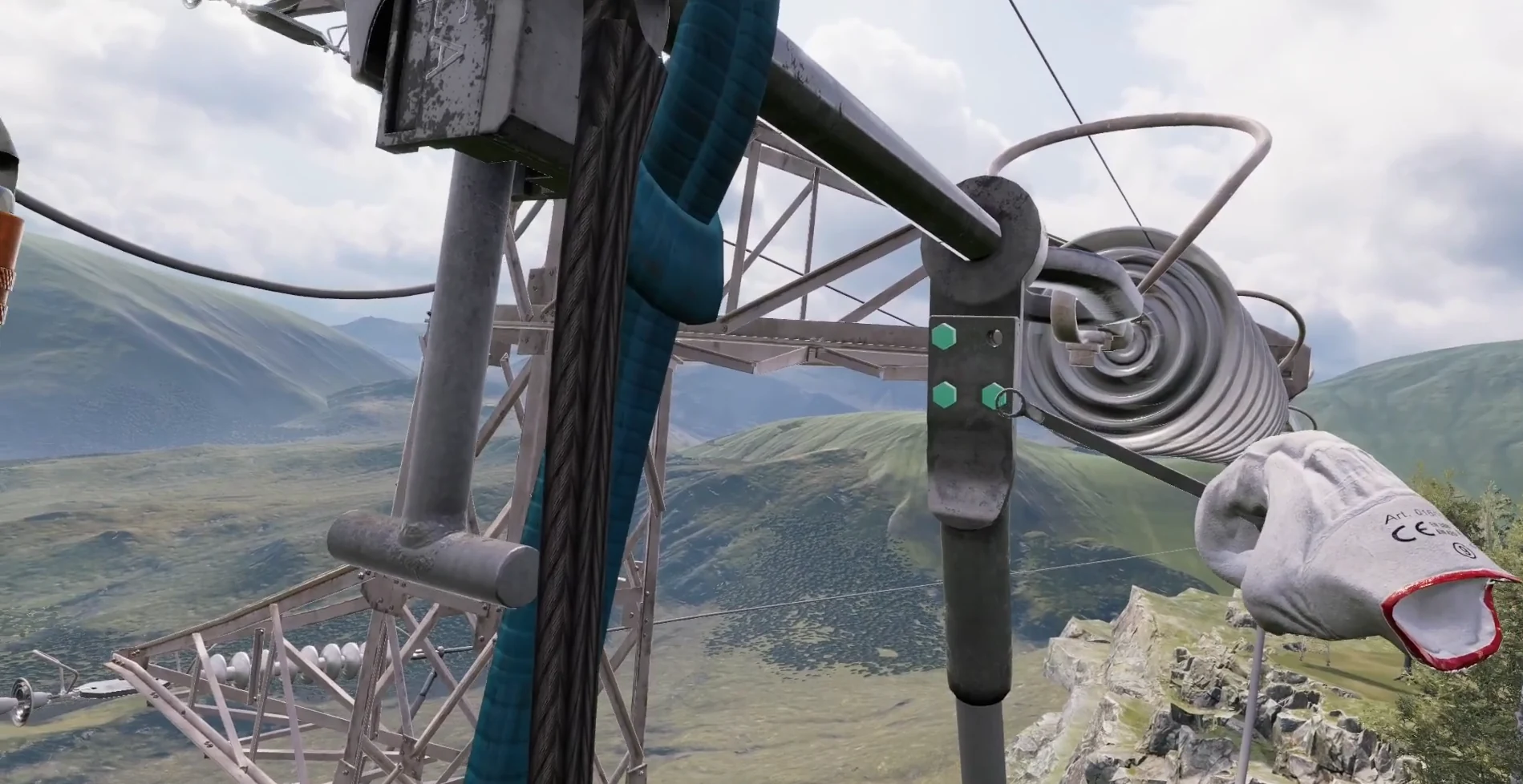
The application digitalizes six different operational procedures on medium-voltage switchgear panels, each developed from photographic surveys conducted directly at the client’s sites. The substation environment is modeled in 3D with high fidelity on the elements relevant to the procedure, and every component is interactable following the same logic as the real world.

Key elements of the solution

  • Pure hand tracking interaction. No controllers. The operator grabs, rotates, moves, and presses using their own hands, exactly as they would on the real equipment. Gestures are natural and lower the barrier to entry for anyone not familiar with gaming technology.
  • Six complete operational procedures. Each switchgear panel (transformer protection, motorized lines, integrated TA-TV, in different configurations) has its dedicated procedure, developed step by step with Unareti’s technicians and validated on the field.
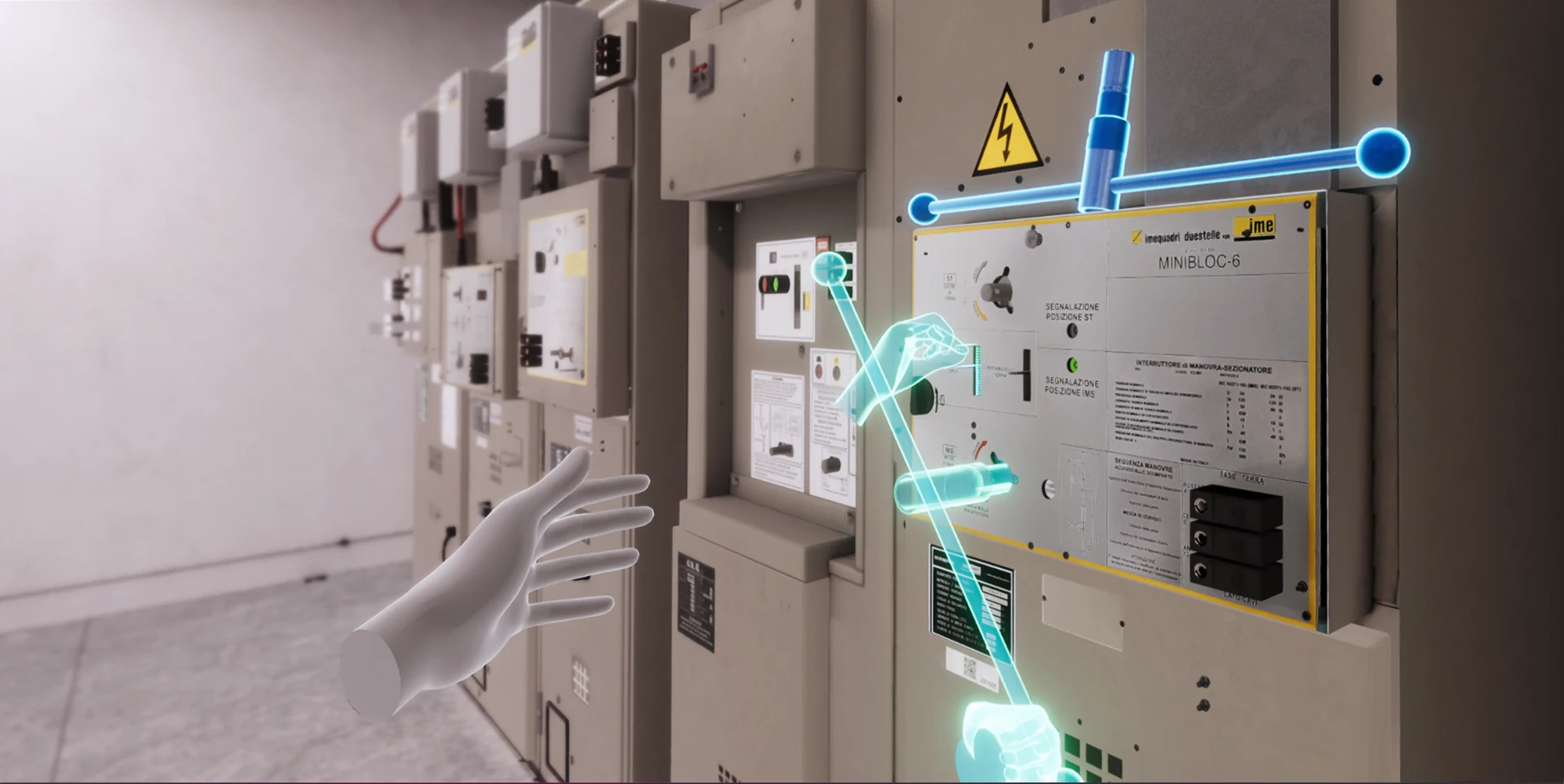
  • Dual training mode. Guided mode for learning, with step-by-step instructions and an activatable 3D holographic tutor showing the correct operation. Assessment mode for autonomy evaluation, with a timer, error counter, and final score.
  • Additional explorable environments. Three static substation configurations that the trainer can use as supporting material during in-person or remote sessions.
  • Native multilanguage. Italian and English, switchable on the fly, to support international teams or training materials that can be shared with foreign partners.
The design

The experience is structured to guide the operator through a complete path of learning, practice, and assessment:

  • Initial tutorial to build familiarity with the environment and hand tracking interactions, making the experience accessible even to those with no prior VR experience
  • Realistic simulations, with direct interaction on levers, switches, and technical components, replicating the same actions performed in real contexts
  • Guided mode, to learn procedures step by step through visual aids that support the user throughout the execution
  • Assessment mode, with no hints and the possibility to make mistakes, to test the acquired competencies in autonomy

The system provides immediate feedback, allowing operators to learn through direct experience.


A2A VR Training - Tutorial

A tutorial to lower the barrier to entry

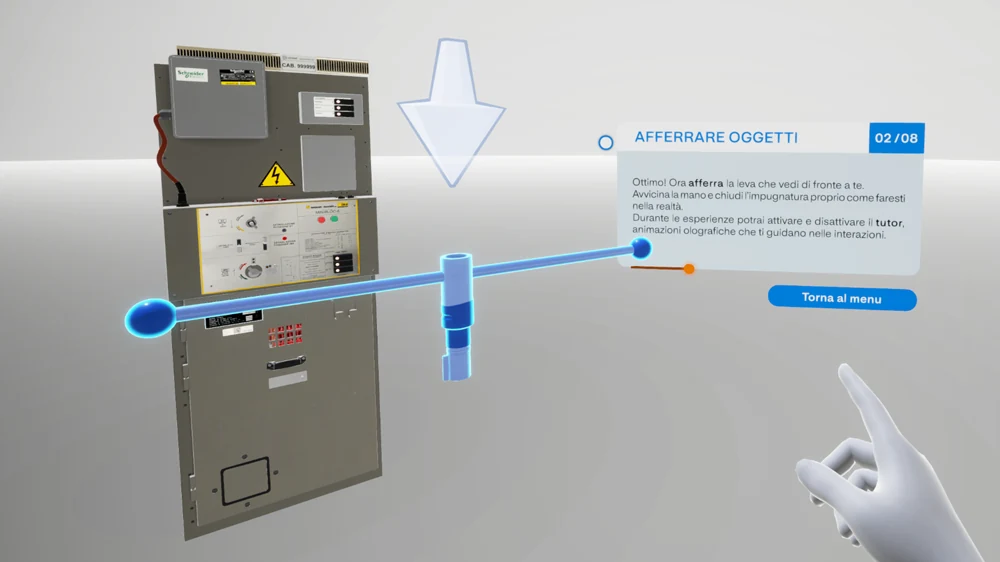
Entering the application doesn’t take the user directly to the procedures. It goes through a short tutorial, deliberately set in a neutral space (an ethereal limbo), designed to progressively introduce the basic interactions in hand tracking: how to teleport, how to grab objects, how to interact with both hands, how to observe visual indicators.
This choice addresses a real problem: electrical grid operators aren’t necessarily digital natives, and putting someone into a complex immersive environment for the first time without preparation produces confusion and resistance. The tutorial is short, linear, and conceptually separated from the operational environment, so the operator can focus on one thing at a time.


AnotheReality - A2A VR training Tutor

The holographic tutor as a guide

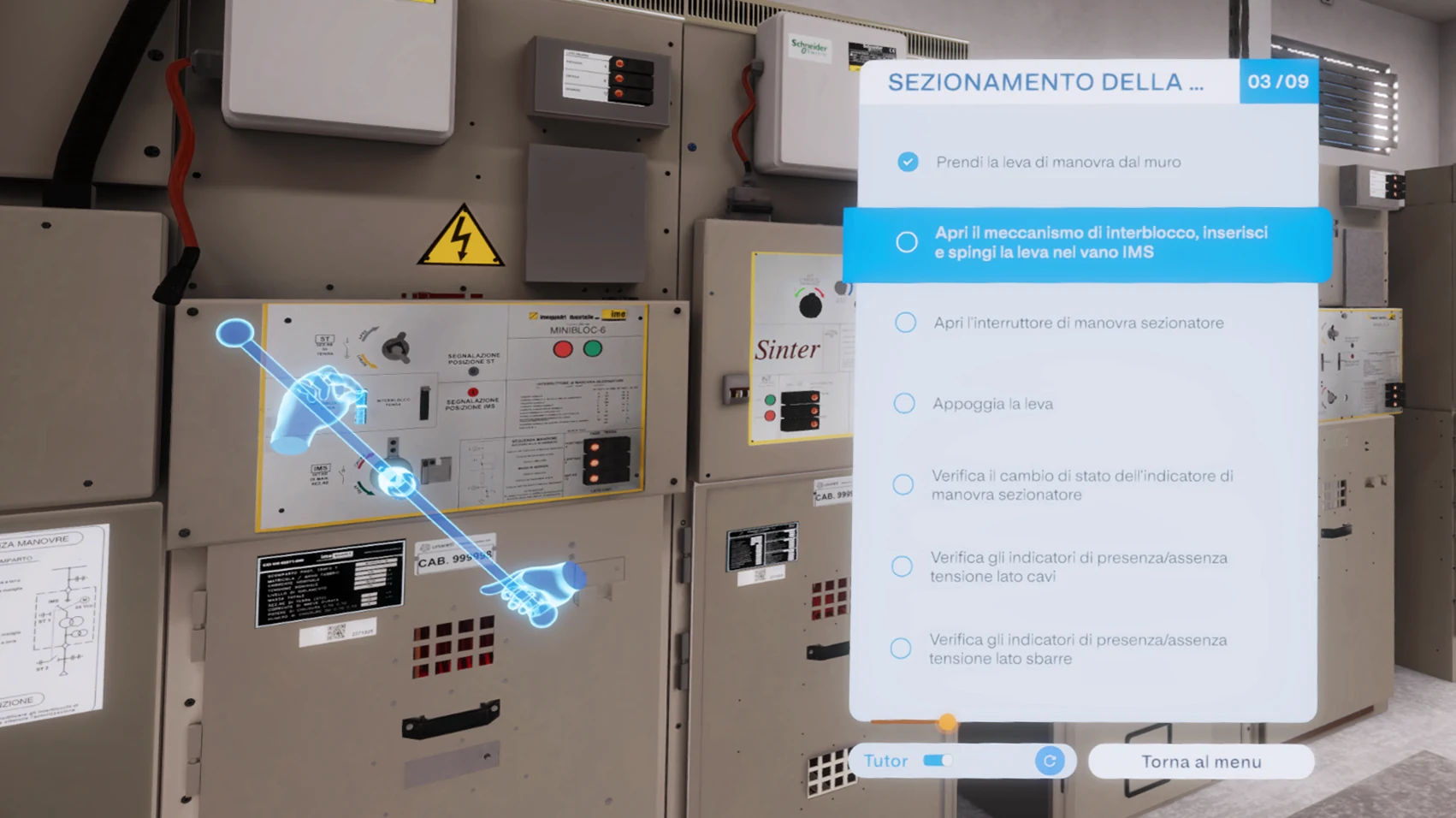
Inside guided mode, an activatable 3D tutor is available via toggle. It’s not an anthropomorphic avatar, but a pair of holographic hands that perform the correct operation directly on the equipment. Representing the tutor as hands, rather than a full human figure, is an intentional design decision: it removes distractions, keeps the focus on the technical action, and is more flexible in terms of positioning within the scene.

The tutor performs the current step’s operation once. The user can decide to summon it for a specific step, or keep it active for the entire session. This flexibility supports different learning curves: first-time users keep it always on, more experienced users only turn it on for complex passages.


AnotheReality - A2A VR Training Modalità verifica

An assessment system for autonomy

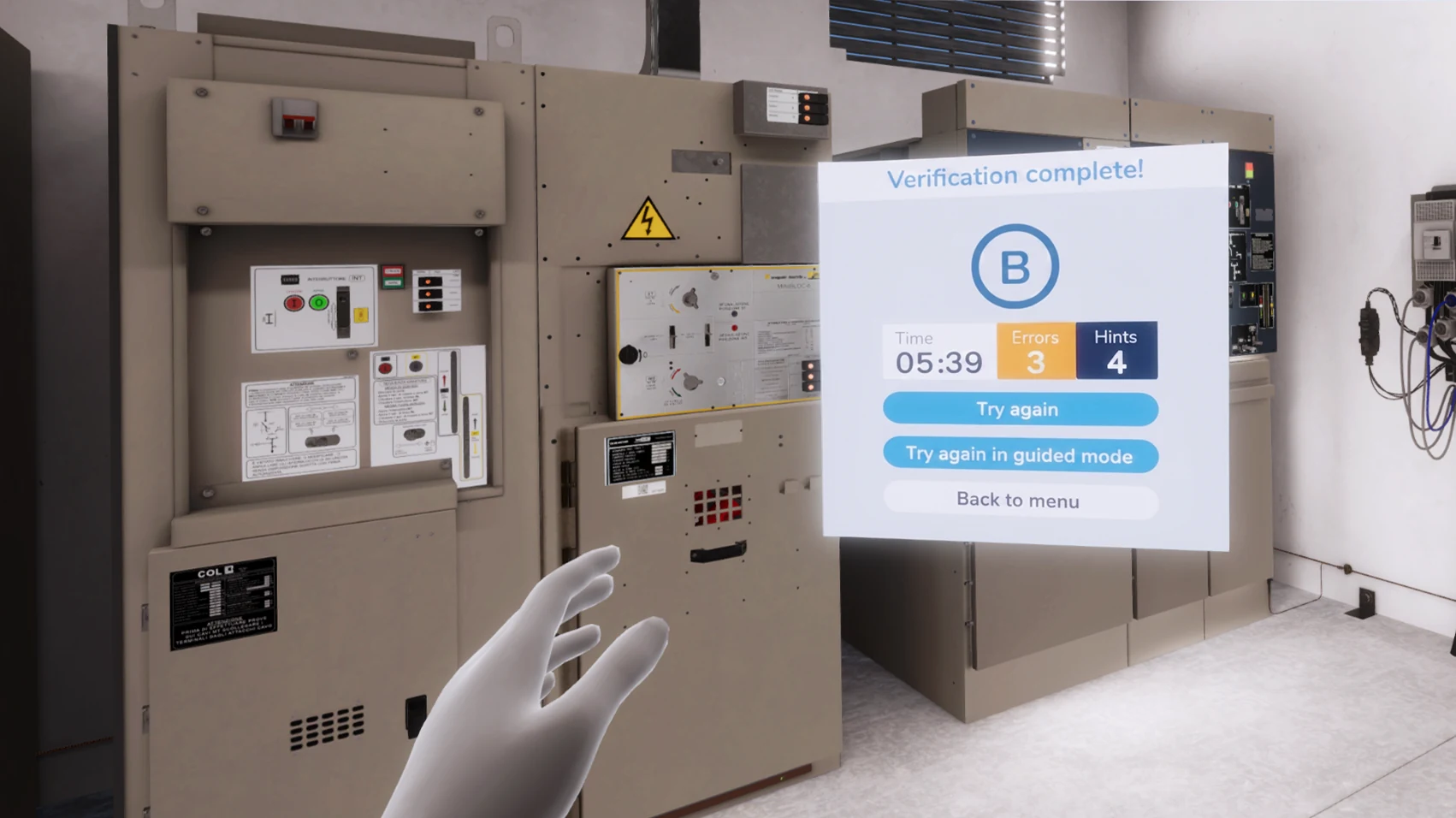
Assessment mode is built to test the autonomy that has been reached. In this mode, the user receives no textual instructions during the steps and must remember the sequence and apply it. The system provides only minimal visual feedback (a green check to confirm a correct action, a warning triangle if the action is performed at the wrong moment).

At the end of the procedure, a summary panel shows the number of errors made, the number of hints requested, the completion time, and a final letter-grade evaluation. The evaluation is clear, immediate, and allows the user to understand where to improve without needing interpretation. If the result isn’t satisfying, the user can immediately retry in assessment mode, or step back into guided mode to review the procedure.

Co-designed with A2A's technicians

The technical value of a procedural simulator doesn’t lie in the graphics, but in fidelity to real procedures. A beautiful environment simulating the wrong procedure is worse than a paper manual.

For this reason, the entire project was developed in close collaboration with Unareti’s technicians. The procedures were formalized step by step in a shared file where, for every action, we defined the interaction type, the object involved, operational notes, and expected feedback. Photographic surveys of the real substations guided the 3D modeling. The animated tutor gestures were calibrated on the actual sequences performed on the field.

During development, the client received progressive builds testable directly on the headset, and provided punctual feedback via video recordings of the sessions. Every iteration allowed us to refine procedures, interfaces, sound and visual feedback, progressively bringing the experience closer to the real equipment’s behavior.

Critical success factors
uniform standards
Every operator goes through the same experience, with the same feedback and the same evaluation criteria. Consistent competence levels across territories, teams, and locations.
measurable readiness
Errors, hints, time, final score. Objective data to answer the question that matters: is the operator ready for the field, or not?
accelerated onboarding
New hires reach the equipment with more exposure to critical procedures than they would have accumulated with the traditional method. Fewer waiting weeks, better preparation at debut.
Impact & results

The project received extremely positive feedback from the technicians involved in the early stages of use, showing high levels of engagement and ease of use.

The solution is currently being adopted within Unareti’s training processes, with the goal of being integrated more broadly into corporate training.

Main benefits:

  • Greater safety during training
  • Practical and effective learning
  • Procedure standardization
  • Scalable and replicable training
Conclusions

The project demonstrates how virtual reality can concretely improve technical training in the energy & utilities sector, turning complex procedures into immersive, safe, and accessible experiences.

Project context: The A2A Training Center was built within a project funded through Start 4.0, the Italian Competence Center for cybersecurity and critical infrastructure security, with NextGenerationEU resources. The project falls under the digitalization initiatives for operational procedures promoted by the Italian Ministry of Enterprises and Made in Italy, and represents a concrete example of how PNRR (National Recovery and Resilience Plan) funds can translate into operational tools that improve the quality of technical training in strategic sectors like energy.